

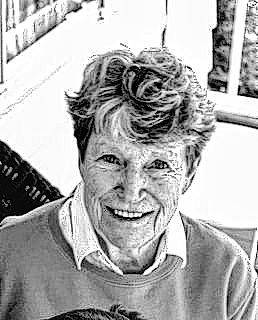
In the mornings I walk my dogs, not so much because they need it but because I do. Every morning I walk the dogs, feed the dogs and my cats and the community cats, water the flowers and the tomato plant, and sit for a few minutes in the garden while it’s still cool. All my days are built on this foundation.
All the while, I think. I don’t have to talk because the dogs already know what I think and the cats don’t care. I think about the particular richness of light on the new green in the trees and shrubs, the amazing colors of the iris and clematis. I watch the Cardinals building a nest in the big althea outside the kitchen window. I know that if I am exposed to this disease, I will die.
Yesterday, walking along Scott’s Creek, I saw a mountain bluebird. It swooped across my path, no more than six feet in front of me, seeming to pluck something off the grass, and never slowing at all. The intense azure blue of that little bird, an arrow of light from the sky itself, was a message, a reminder to celebrate the beauty of the Earth. If you have never seen a mountain bluebird, that’s not surprising. This one was probably a long way from home. Pull up the pictures on the internet and imagine it’s flight at eye level right in front of you.
I am a writer. Everything means something. That is a gift and a burden. Thoughts and images are fleeting, and if I do not catch them in some kind of net, words on the page, they are gone. My net has been broken. Since our lives were swallowed up in the pandemic, I have found it hard to think beyond the beauty of South Carolina in the spring. I know that if I am exposed to this disease, I will die.
In the first weeks of the pandemic when we were all stunned by the very idea, just waiting to see what was happening, we were obsessed with the news. Every day, we counted the cases that we know about, not so many since we were almost without tests, and we have counted the fatalities. The deaths of old people were offered up by all the news outlets as a palliative reassurance to all the people who are not yet old. “Don’t worry,” they were saying. “You’re not at risk of dying, unless you’re old or sick.”
We have a habit of thinking this way. When an old person dies, it is the customary to say, “At least, he (or she) had a good long life.” Wrong thinking! A good long life is not a good reason to die. One of my favorite poems demands: “Do not go gentle into that good night. Rage, rage against the dying of the light.” I will. I have a book to finish.
As for the loathsome politicians and commentators who argue that we, the old people, are on our last legs anyway and should be willing to die for a strong economy, we can only laugh and take note of the fact that rich people are not exposed to this disease. Poor people are, homeless people are, health care workers, first responders, food service workers, grocery store workers, truck drivers, delivery workers, postal service workers, factory workers, all these are exposed, but not loathsome old politicians, and not old rich people.
None of us are old enough to remember what life and death was like during the Spanish Flu in 1918, and very few of us can imagine what life has been like in recent wars in the Middle East, when ordinary people like ourselves have died by the thousands, from causes which they could not escape or control.
This nation, our America, has never had to mobilize to face a challenge like this one. In a situation which remains largely unimaginable for those of us who have not been engaged in the hand-to-hand struggle to save lives, more than 50,000 people have died terrible deaths, struggling to breathe, suffocating and alone. We cannot even comprehend so much grief, so much suffering.
Many, many more people have been damaged for life and will never fully recover. We are warned that this pandemic might be just the beginning, that it can get worse, and that it may come back, again and again. We are fighting a war, the pandemic of a dangerous disease, without the equipment we need, without the scientific leadership we need, without the national unity we need.
It is unconscionable, immoral, obscene, that farmers are forced to leave food rotting the fields, to pour milk on the ground, when half the world is hungry. Where is the humanitarian leadership in our country? Where, for goodness sake, is the Department of Agriculture? What has happened to FEMA that they wrestle medical supplies from the states and the hospitals that have tried to purchase them?
We can find a way to test everyone so that those who are infected can stop spreading the disease, and those who are not infected or who have recovered can return to work. Testing is the only intelligent, practical, efficient way to proceed. Where are the tests that we need? Social distancing and the half-open businesses will help, but they will not solve the medical problems or the economic problems, the life or death problems that we face.
.neFileBlock {
margin-bottom: 20px;
}
.neFileBlock p {
margin: 0px 0px 0px 0px;
}
.neFileBlock .neFile {
border-bottom: 1px dotted #aaa;
padding-bottom: 5px;
padding-top: 10px;
}
.neFileBlock .neCaption {
font-size: 85%;
}