
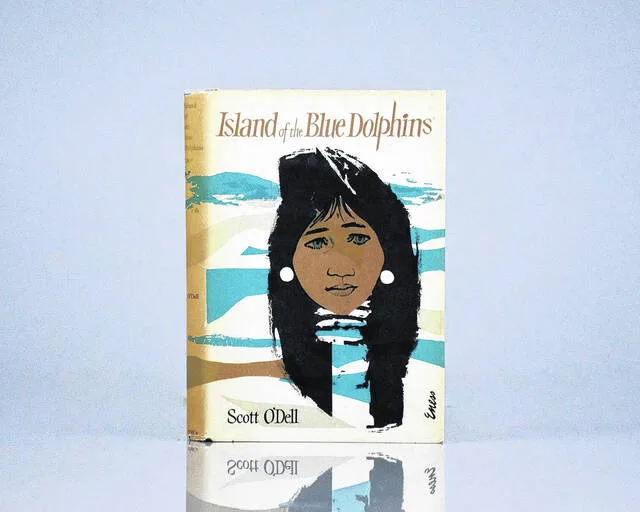
Could you survive alone on a deserted island with nothing but your wits keeping you alive for eighteen years, you might ask and I’m glad you did because the real life story of Juana Maria, featured as the character Karana in Scott O’Dell’s novel “Island of the Blue Dolphins” examines this very scenario. Many American children read the novel in school seldom realizing the true nonfiction story of survival behind it.
O’Dell’s novel, published in 1960, follows the life of Karana, a native of the San Nicolas Island off the coast of California who is left alone fwhen her tribe suddenly leaves. Because her brother refused to go with the tribe, Karana also chooses to stay behind. When her brother dies, the young woman is left entirely alone. For Karana, the story is fiction. For Juana Maria, a young Native American mother who elects to stay behind and remain on San Nicolas Island when her son refuses to leave with their tribe, it is very real.
In 1835, Captain Charles Hubbard arrived on the island and began evacuation of Juana Maria’s tribe aboard his ship the Peor es Nada. As the story goes, a sudden storm erupted along the island’s shoreline, ramping up the evacuation schedule, and causing Juana Maria, or the “Lone Woman” as she later became known, to be left behind with only an obstinate child for help and companionship.
Becoming the “Lone Woman”
Days turned into weeks, months into eventual years, and still Juana Maria and her son thrived alone on the island. A native, the young mother relied on skills learned in her youth and passed along to her son, to provide them with shelter and sustenance.
It was during the act of procuring such sustenance that tragedy eventually struck—Juana Maria’s son was killed while fishing near the shore. A possible shark or orca attacked his canoe, overturning and killing the young man. Juana Maria would go on to survive another 18 years alone on the island.
How did the “Lone Woman” Survive?
Following the ways of her tribe, Juana Marie favored homes of round brush hut that stretched roughly 6 feet wide and reached 5 feet high. To strengthen the bones of her shelter, Juana Maria used actual whale ribs and other bones. Like cavemen of old, she also relied on the insulation of a nearby cave for protection and to cook over open flame.
Juana Maria made many of the tools and supplies she needed to survive, including needles, sewing supplies, baskets, water containers, fishing hooks, and a tiny knife.
An islander, her diet came mostly from the ocean and included seal blubber, seal meat, fish, shellfish, roots, plants, and bird eggs. Having no freshwater sources readily available, Juana Maria collected rainwater to drink. She preserved seal meat by hanging it from poles and ropes. Her life fully sustained by the island, Juana Maria also made fishing lines from sinew and wore clothing made from raw materials, including dresses of green cormorant feathers woven expertly together with sinew and cozy garments made from wild duck skins and feathers.
Discovered at Last
Rumors of sightings of a “Lone Woman” on San Nicolas Island began to widely circulate on the mainland and in 1939, and Juana Maria’s legendary whale-bone hut was also spotted.
Reaching folklore status by this point, in 1850, Father Gonzales paid Thomas Jefferies $200 to find the “Lone Woman,” but this search ended in failure. Because every good folk story survives on a little bit of truth to keep it going, Jefferie’s search uncovered small human footprints left in the sand approximately 200 yards from the shoreline. Sailors continued to report sightings of a woman running in the fog along the beach.
Believing the woman to still be alive kept hope, and search efforts, going.
Another crew of searchers made an attempt to find her on July 21, 1853.
Finding many signs of life scattered about, the group continued searching until for the first time in 18 years the “Lone Woman” of San Nicolas Island locked eyes with another human being. They found her surrounded not by blue dolphins, but instead, man’s best friend.
In an achingly human moment, Juana Maria was eventually discovered in her element: thriving and wild, near three self-constructed whale bone huts with a pack of feral island dogs circling her feet.
Life on the Mainland is not all it’s cracked up to be
Sometimes wild things don’t need to be “saved.”
Removed from her ecosystem, Juana Maria thrived for a moment but could not survive modern life.
At the time of her discovery, Juana Maria was described by her “rescuers” as about 50- years- old, of stocky build, physically active and receptive to their advances towards friendship. She was also said to show very little fear and demonstrated an easy, fast smile.
Around September 1, 1853, Juana Maria was persuaded to sail to Santa Barbara. After arriving, she stayed in the home of Captain Nidever and his Spanish wife, María.
In California, Juana Maria experienced many unfamiliar sights, including horses. Reportedly, when she first saw a horse and its rider, she believed the two together formed one beast. Visitors brought her fruit as gifts, and she often sat on the back porch looking out toward the ocean— perhaps dreaming of another life lived beyond the waves.
The fast-paced nature of Juana Marie’s new life eventually caught up with her and just seven weeks after arriving in Santa Barbara, she became ill with dysentery. It is widely theorized diet may have played a role in Juana Marie’s abrupt demise on October 19, 1853. Her new steady diet of fresh fruits, vegetables, and green corn may have contributed to her developing dysentery.
Before she died, Father Sanchez baptized her and gave her the name Juana Maria. Father González Rubio recorded the baptism as conditional because her language could not be understood. Juana Maria died on October 19, 1853, and was buried in an unmarked grave in the Nidever family plot at the Santa Barbara Mission cemetery.
Lore of the “Lone Woman” lives on
Not only preserved in O’Dell’s beloved coming of age novel “Island of the Blue Dolphins,” curiosity seekers can find out more about Juana Marie lore by visiting the Channel Islands National Park visitor center located at 1901 Spinnaker Drive in Ventura. Boat rides touring the islands are also available.